Zdenka discovers Tomáš and Eve’s relationship
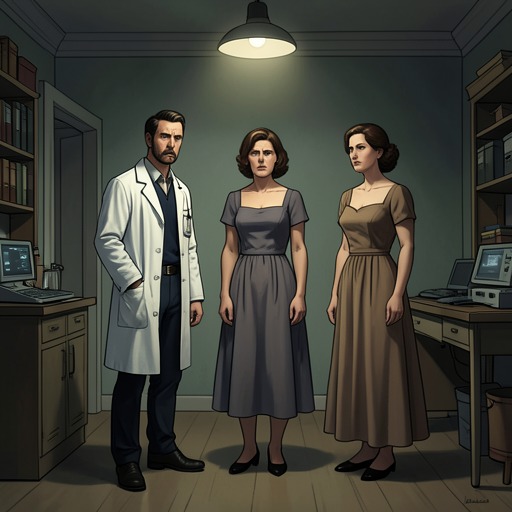
The Glass RoomZdenka discovers Tomáš and Eve’s relationship not through a confession or confrontation, but through the unobtrusive detail of their hands in a photograph. The camera records what Tomáš and Eve have kept out of sight, turning a suspicion Zdenka had already begun to understand into plain evidence of betrayal. The discovery takes place amid a quieter exchange with Hana: Zdenka has just danced in the Glass Room, and Hana has brought photographs that connect the present occupants of the house with its lost past.
Suspicion and the Dance
Before the photographs are examined, Zdenka already knows more than Tomáš has said. When he claims that his connection with Eve is over, she hears a pause and understands that the encounter is not finished. She does not mention her inference. The knowledge remains unspoken, but it shapes what follows: she can suspect the affair without yet possessing proof.
That evening, in the Glass Room, Zdenka dances for Hana. The curtains are drawn, and the lights cast pale-gold pools across the floor. Instead of Ravel, she chooses sorrowful piano music by Janáček, composed while he mourned his daughter, Olga. Zdenka improvises a dance of death before the onyx wall. The music echoes through the room, and the performance gives form to several kinds of mourning at once: the Landauer family who once lived in the house, Hana’s husband, who died in Auschwitz, and Zdenka’s love for Tomáš, now becoming a memory she expects to cherish and regret.
The dance is also a performance Zdenka never achieved onstage. She imagines the professional life that might have taken her to Prague, Leningrad, or Moscow, but her circumstances changed after she fell and broke her ankle. In the Glass Room, she performs the work that eluded that life, not before a public audience but for Hana. Hana watches with rapture and does not applaud. Zdenka kneels beside her and takes her hands, a gesture of comfort that precedes Hana’s disclosure.
The Photographs as Evidence
Hana turns to the briefcase she has brought. It contains the promised photographs and one of her own, almost the only thing she says survived from before the war. An older photograph shows Viktor and Liesel with Martin and Ottilie. Hana recalls that Ottilie was her goddaughter, though Viktor disapproved of Liesel’s choice and Hana says she thinks she agreed with him. Looking at the picture, Hana remembers the family’s happiness. Its age gives it a weight the newer images cannot possess.
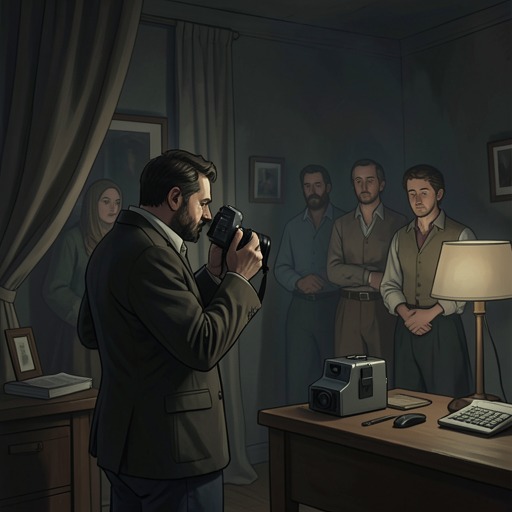
The recent photographs, taken in the house only days earlier, are bright, polished, and professionally composed. They show the building from the garden and its interior, including the gym with exercise mats laid in a row before the onyx wall. Other images use a fisheye view of the entrance hall, in which the figures seem to swim within the lens. A group photograph in the Glass Room gathers Hana and Zdenka on one side and Tomáš and Eve on the other, while the chairman of the District Committee stands apart from them.
In that group photograph, Tomáš and Eve are holding hands. The gesture is almost hidden. Eve has a notebook against her chest; Tomáš rests one hand on a chromium pillar, while his other hand is concealed from the people on the opposite side of it. The camera, however, catches his hand clasping Eve’s, their fingers intertwined. The arrangement makes the intimacy legible precisely because the couple have tried to keep it out of view. It is not an accidental touch: the interlaced fingers suggest familiarity and a closeness that has been practiced beyond the moment of the photograph.
From Intuition to Recognition
The photograph changes the force of what Zdenka knows. She had already suspected that Tomáš’s claim that the affair was over was untrue, but suspicion could still be treated as memory or imagination. The camera’s record removes that refuge. Its image is steady and visible; in it, Tomáš’s hidden hand makes the betrayal concrete. Zdenka is shocked not simply because the image confirms what she feared, but because seeing the proof is different from privately anticipating it.
Hana explains that she did not know how to tell Zdenka and did not want to hurt her. She also did not want Tomáš to continue deceiving her. Putting an arm around Zdenka’s shoulders, Hana offers comfort while making clear why she showed her the photograph: silence would have spared Zdenka an immediate hurt, but it would have left the deception in place. The disclosure therefore places Hana between care and painful honesty, and her choice gives Zdenka the evidence she needs to understand the relationship’s actual state.
Aftermath and Significance
Zdenka accepts Hana’s comfort for a while, then excuses herself to wash and change. Looking at herself in the mirror, she sees not the sophisticated adult who has been to the West, to Paris, and to an international medical conference, but a bruised, pale, washed-out young girl. The contrast registers how sharply the discovery unsettles her composed adult identity. She asks herself what Hana will think of her, and, when she returns to the gym, feels the need to apologize for burdening Hana with her unhappiness.
The scene binds private betrayal to the house’s layered memory. The Glass Room holds the old family photograph and the recent group portrait, a record of people who once lived in the house beside an image of its current visitors. The onyx wall and chromium pillar belong to the same modern interior that frames both Zdenka’s mourning dance and the hidden handclasp. In this setting, photography’s apparent neutrality becomes consequential: the camera reveals an intimacy that its participants have concealed from the people around them. Zdenka’s discovery is thus a recognition scene in a literal sense—an image turns what she intuited into something she can see—and the end of her belief that Tomáš’s affair with Eve is merely past.